The National Proved Fandom Is Commerce
Five days at the Donald E Stephens Convention Center in Rosemont, July 29 through August 2. The card business has been running live commerce for forty years and just showed everyone exactly how, on a convention floor that opens once a year and moves a startling amount of inventory.
Five days at the Donald E Stephens Convention Center in Rosemont, July 29 through August 2. The card business has been running live commerce for forty years and just showed everyone exactly how, on a convention floor that opens once a year and moves a startling amount of inventory.
Forty Years of Live Commerce
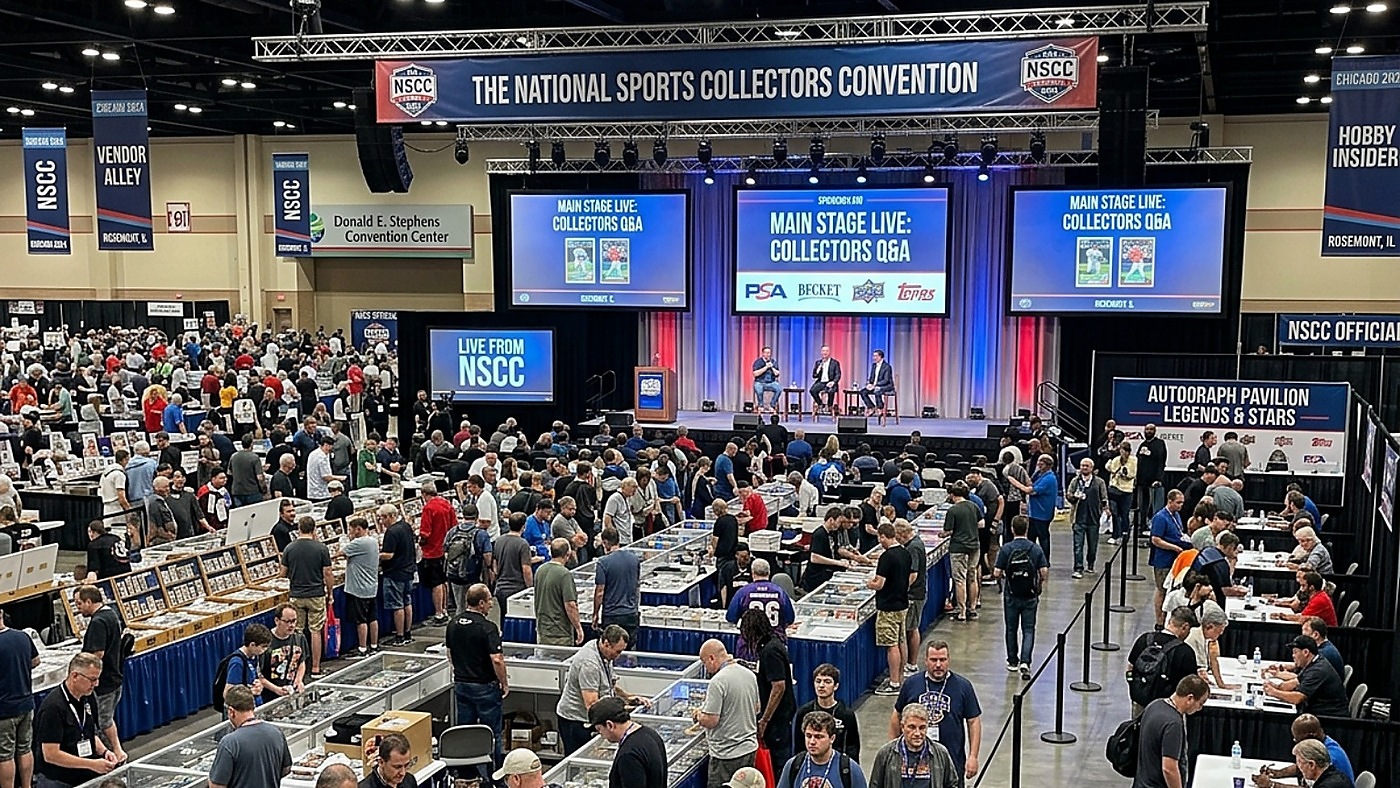
From July 29 through August 2, the National Sports Collectors Convention fills the Donald E Stephens Convention Center in Rosemont, just outside Chicago. For five days the floor holds rows of dealer tables, company booths, grading counters and autograph lines, and a crowd that arrives with cash, cards to sell and a list of what it came to find.
The show has been running since 1980. Long before anyone used the phrase live commerce, the card business was doing it in person. A seller holds up an item, a buyer asks a price, the two negotiate in public, and a deal closes in front of a crowd that is watching and learning what everything is worth. The National is that exchange at its largest.
What makes it worth studying is not the size of the room. It is how much inventory moves in five days, how quickly prices settle, and how little of it depends on advertising. Nobody is persuaded to care about cards at the National. They arrive already caring, and the floor is built to turn that into transactions.
Most brands spend their budgets trying to create that kind of audience. The hobby built one and then gave it a place to shop.
The Floor Is the Store
Walk the aisles and the structure becomes clear. The largest card companies take big booths near the front, where they show new releases and hand out promotional cards that exist only at the show. Behind them sit hundreds of independent dealers, each running a small shop for five days, with glass cases arranged by player, team and year.
Grading companies set up counters where collectors can hand in cards and have them authenticated and scored. That grade can change a price completely, so the grading line is part of the selling process, not a side service. Autograph areas sell timed signings with current and retired players, which turns an athlete's afternoon into inventory.
More and more of the floor is also broadcast. Sellers open boxes on camera for viewers who have bought a share of whatever comes out, and the same moment reaches buyers at home who could never make the trip. The convention floor and the phone screen now run as one market.
Every part of the room is designed for the same outcome. Show the product, prove it is real, set a price in public and close the sale while the buyer is still standing there.
Scarcity, Proof and a Crowd
Three things make the model work, and none of them is unique to cards. The first is scarcity. Show exclusives, numbered parallels and one of one cards give people a reason to be in the room this week instead of next month. Buyers do not wait when waiting means the item is gone.
The second is proof. A graded slab, a certificate from a signing, a dealer with a reputation built across decades of shows. Collectors pay more when they trust what they are buying, and the National puts that trust on the table next to the product. Uncertainty is the thing that kills a sale, and the room removes it.
The third is the crowd. Prices at the National are shaped by thousands of people comparing, watching and talking. When one dealer sells a card, the aisle hears about it. That shared signal is what keeps the market liquid, because everyone can see what things are actually trading for.
Put those three together and the discount almost disappears from the conversation. People pay full price, and often more, because the event gives them something a listing online cannot.
What Every Brand Can Take From It
The card business rarely gets credit as a model for anyone else. It should. It has spent more than forty years running live selling at scale, long before the apps and the streams made the format fashionable, and it still does it better than most retailers who discovered it recently.
The lesson for any brand is that fandom is not a mood to be measured in likes. It is a commerce category with its own calendar, its own rituals and its own willingness to spend. The companies that treat their fans as buyers, and give them a place and a reason to buy, are the ones that turn attention into revenue.
That does not require a convention center. It requires a limited release people know about in advance, proof that the product is what it claims to be, and a moment where the audience gathers and sees each other buying. A launch night, a members event or a live drop can carry all three.
The National opens once a year and moves a startling amount of inventory while it does. Every brand with a loyal audience should be asking what its own version of that floor would look like.